
Anyone who wears prescription specs knows the routine. You book an eye test, sit in the examination chair for twenty minutes, and then get guided straight over to the display stands. Before you know it, you are looking at rows of frames where the price tags already seem steep. By the time you add anti-scratch coatings, lens thinning and UV filters at the checkout counter, the final bill easily tops two or three hundred pounds.
For years, people simply paid up without asking many questions. Clear eyesight is not a luxury you can decide to skip for a month to save a bit of cash. If you need corrective lenses to drive your car or do your job, you pay what the shop asks.
However, looking at the situation from a purely financial perspective, the traditional optical business has carried some of the heaviest retail markups on the high street. The rise of digital retail has completely broken that cycle. Choosing to buy glasses online is no longer just a trend for tech-savvy shoppers; it has become a straightforward money-saving strategy that cuts out middlemen without cutting optical standards.
Why High Street Specs Cost So Much
To understand why buying frames online saves so much money, you have to look at the bills a physical shop has to pay before they even sell a single pair of glasses.
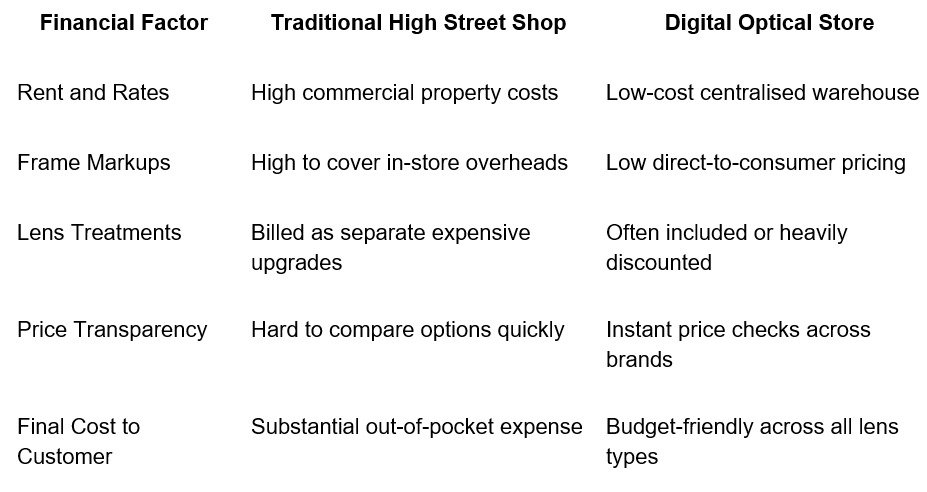
A high street optician sits on expensive commercial property. They have to pay prime town centre rents, local business rates, heating, lighting, and wages for a full team of retail and dispensing staff. On top of that, they keep hundreds of sample frames sitting on shelves just so customers can browse them. That means thousands of pounds of company money is tied up in physical stock that might sit untouched for months.
All of those business costs get added directly onto the final price tag of your eyewear. A piece of moulded acetate or metal wire that costs relatively little to manufacture ends up priced at ten times its base production cost simply to keep the physical shop running at a profit.
Add-on treatments are another area where prices escalate quickly. Things like anti-reflective layers, scratch protection or basic blue light filters cost modern optical labs pennies to apply in bulk. In a physical shop, however, each one is often presented as an expensive separate upgrade.
How the Online Model Cuts the Bill
Online optical retailers work from a completely different financial setup. Instead of running dozens of small shops across different towns, they operate out of central labs and distribution warehouses where overhead costs are a tiny fraction of high street retail spaces.
When you buy glasses online, the supply chain is stripped right back:
● Lenses are cut and fitted straight in the central lab, avoiding third-party courier fees between multiple shops.
● Centralised stock systems mean less money is wasted on unsold frames gathering dust.
● The absence of expensive shop leases allows retailers to keep profit margins fair and competitive.
● Lens coatings and thinning options are usually bundled in at cost price rather than treated as expensive extras.
The difference in what comes out of your bank account is substantial. An optical prescription that easily runs over two hundred pounds in a town centre practice can often be fulfilled online for less than fifty, using the exact same prescription parameters and optical lens grades.
A Look at the Numbers: Traditional vs. Online
The Story with Designer Glasses
The savings become even more noticeable when you look at luxury brands. In a traditional boutique, genuine designer glasses come with an extra layer of prestige pricing. Shops know that customers recognise luxury logos, so they charge top-tier prices to match the brand name.
Online dispensaries handle luxury frames much like any other product. Because they purchase stock in large volumes and sell directly to customers across the country, they can offer authentic designer glasses at much lower prices than a local boutique can manage. You still get the original branded frames, the proper case and the official certificate of authenticity, but you avoid paying the retail premium that usually comes with a luxury storefront.
What About Getting the Fit Right?
In the past, the main reason people hesitated to order eyewear on the web was the worry that the frames would arrive and not fit their face properly. Nobody wants to spend money on something they cannot return if it pinches their nose or slips down their cheeks.
That problem has largely been solved by modern technology. Most good digital optical sites now give you tools that make ordering reliable and low-risk:
● Virtual try-on features use your phone camera to show exactly how a frame sits on your face in real-time.
● Frame measurements (lens width, bridge size, and arm length) are listed down to the millimetre so you can match them against a comfortable pair you already own.
● Free digital tools help you measure your pupillary distance accurately in thirty seconds using a standard card and a smartphone.
● Flexible return windows and home try-on services mean you are not stuck with frames if they feel uncomfortable in person.
The Smart Way to Handle Your Eye Care
If you want to keep your vision sharp without spending more than you need to, the best approach is to separate the medical check from the retail purchase.
In the UK, an optician is legally required to hand you a clear, written copy of your prescription immediately after your eye test. You are under no obligation to buy frames from the person who tested your eyes.
The smartest financial move is straightforward: pay for your professional eye examination with an optometrist to make sure your eyes are healthy, take your paper prescription home, and then order your glasses online where the prices are fair and transparent. You get the full benefit of professional medical care alongside the cost savings of the digital market.
Final Thoughts
The optical industry has changed for good, and consumers are the ones winning out. You no longer have to accept high markups, confusing add-on pricing, or expensive store fees just to get a pair of glasses that helps you see properly.
Whether you need a simple backup pair of reading glasses, complex varifocal lenses, or a pair of designer glasses that fits your daily style, buying online gives you control over what you spend. It is a practical, modern shift that keeps your eyes healthy, your vision sharp, and your bank balance in much better shape.