
Cixi, Zhejiang, China - September 3, 2026 -
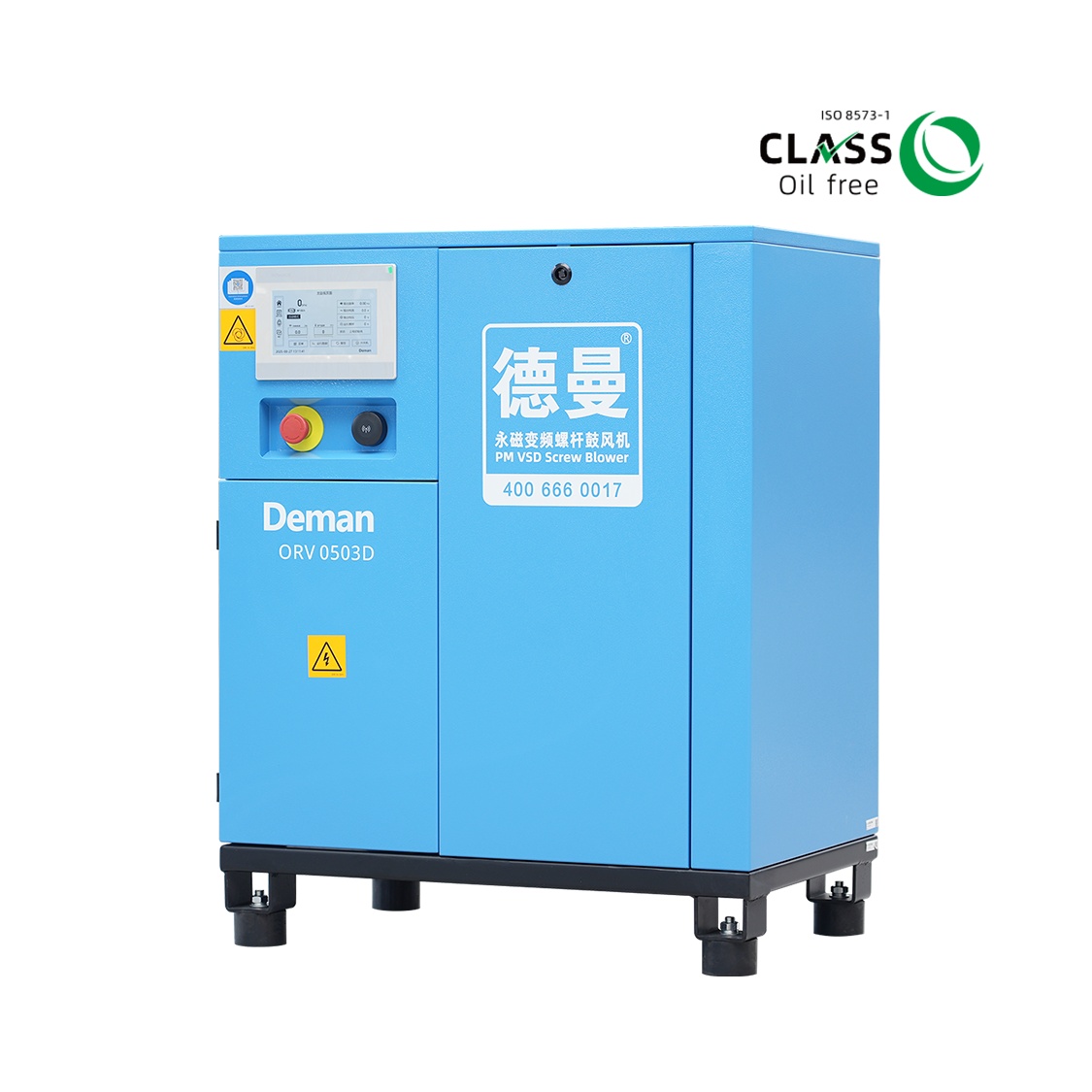
A Class 0 certified PM VSD oil-free screw blower — the unit behind the certificate.TL;DR — what an ISO 8573-1 Class 0 test report actually proves: It proves three core numbers — total oil concentration below 0.01 mg/m³, pressure dew point and particulate count — measured to a published method on a specific unit under specific test conditions. It does not prove the same numbers on the next unit off the production line, nor does it prove sustained performance over the unit's service life. The five fields that buyers most often miss are test temperature and pressure, sampling flow and port, test lab accreditation, certificate validity and the test method citation. Together these eight fields define what an ISO 8573-1 Class 0 certification can and cannot prove, and the rest of this guide is built around that definition.Why "Class 0" is a compliance concept before it is a performance concept
"Class 0" is the strictest purity tier in ISO 8573-1:2010, the international standard for compressed air purity. The standard sets a total oil concentration ceiling of less than 0.01 mg/m³ — roughly one thousand times tighter than Class 1, the next tier down. For an auditor reading a certificate, the headline number is the actual measured value in mg/m³; for a procurement engineer writing the spec, the headline is whether the value clears the application threshold that the FDA, the FSMA preventive controls framework or the customer quality agreement sets.
The phrase is widely used in marketing because it is short and visually striking, but a test report is what proves it. A Class 0 sticker on a compressor cabinet, a Class 0 banner on a website, or a "Class 0 certified" line in a sales deck is not the same document as a Class 0 test report. The first three are claims; the last is evidence. Plant engineers in food, pharmaceutical and electronics manufacturing need the evidence.
The compliance driver behind the standard matters. In the US, FSMA Section 117.130 treats compressed air that contacts food as a known or reasonably foreseeable hazard, and the preventive controls framework expects an objective verification — typically the Class 0 test report. In US pharmaceutical manufacturing, 21 CFR Part 211.63 and 211.68 require equipment to be appropriate to its intended use, and the same test report is the objective evidence. In semiconductor fabs, the wafer-yield cost of a single hydrocarbon event makes Class 0 the default spec. The Class 0 oil-free blowers product category on the Deman website is anchored to these three regulatory frameworks.
This is why a procurement specification that says "Class 0" is incomplete. A specification that says "Class 0 with a current test report from an ISO 17025 lab, citing ISO 8573-2 for oil aerosol, on the specific serial number to be delivered" is complete. The eight-field checklist below is the practical translation. The published standard is the ISO 8573-1:2010 compressed air purity reference, which sets the Class 0–6 tiers that this guide refers to throughout.
ISO 8573-1 Class 0 — the full purity ladder at a glance
ISO 8573-1:2010 publishes seven purity tiers for each contaminant class. The table below shows the total oil concentration ceiling at each tier, the typical application where the tier is specified, and the relative order of magnitude. Class 0 sits at the top, but the standard deliberately leaves it open — Class 0 means "stricter than Class 1, by an amount agreed between supplier and user." The de facto Class 0 ceiling of less than 0.01 mg/m³ comes from the equipment capability of modern oil-free compressors, not from the standard text.
| Class | Total oil concentration (mg/m³) | Typical application | Order of magnitude |
|---|---|---|---|
| 0 | < 0.01 (agreed, equipment-defined) | Food contact, pharma aseptic, semiconductor process | Parts-per-billion range |
| 1 | ≤ 0.01 | Pharma utility, electronics cleanroom pneumatic | Parts-per-million range |
| 2 | ≤ 0.1 | Instrument air, general manufacturing | 0.1 mg/m³ |
| 3 | ≤ 1 | General plant air, paint spray | 1 mg/m³ |
| 4 | ≤ 5 | Sandblasting, heavy machinery | 5 mg/m³ |
| 5 | ≤ 25 | Workshop air, non-critical applications | 25 mg/m³ |
| 6 | ≤ 50 | Open workshop, no product contact | 50 mg/m³ |
Three observations follow. First, the jump from Class 1 to Class 0 looks small on paper (0.01 to < 0.01) but in practice Class 0 measurements come back at one quarter to one third of Class 1, because modern oil-free compression stages cannot be tuned to "almost zero." Second, the absolute Class 0 number is not defined by the standard text — it is defined by what the supplier can demonstrate and what the auditor will accept. The Deman PM VSD oil-free screw blower is measured below 0.003 mg/m³ at the outlet under typical operating conditions, well within the < 0.01 mg/m³ ceiling. Third, the table is a useful sanity check for any certificate: if the number on the certificate is in the 0.1 to 5 mg/m³ range, the unit is not Class 0 no matter what the marketing material says.
The eight fields on a Class 0 test report — what each one actually means
A Class 0 test report is a short document — usually two to four pages — with eight fields that an engineer needs to read carefully. The eight fields below are the same checklist Deman engineering runs before accepting a third-party certificate from any test lab.
| # | Field | What it tells the buyer | What to flag if missing |
|---|---|---|---|
| 1 | Total oil concentration (mg/m³) | The headline number; must be < 0.01 mg/m³ to qualify as Class 0 | "Pass" without a number; "Class 0" without a unit |
| 2 | Pressure dew point (°C PDP) | Moisture content; industry typical +3 °C PDP for plant air, −40 °C PDP for instrument air | Not stated, or reported in a non-standard unit |
| 3 | Particle size and count (per m³) | Solid particulate; reported per ISO 8573-3 class | "Clean" without an ISO 8573-3 class |
| 4 | Test temperature and pressure | Operating conditions under which the test was performed | Not stated; certificate is then non-reproducible |
| 5 | Sampling flow and port location | Where the air sample was drawn from; compressor outlet vs downstream of dryer | "Outlet" without specifying which outlet in multi-outlet units |
| 6 | Test lab name and accreditation | Whether the lab holds ISO 17025 accreditation for the relevant method | Lab named without an accreditation number |
| 7 | Certificate issue date and validity | How long the certificate remains valid; recertification interval | No issue date; no recertification plan |
| 8 | Test method citation | ISO 8573-2 (oil aerosol), ISO 8573-3 (particle), ISO 8573-4 (microbiological) | Test method not cited; certificate is method-ambiguous |
The eight-field checklist is a fast audit tool. A buyer can usually read the certificate end-to-end in five minutes if these eight fields are present and legible. The most common omission on factory-issued certificates is field 6 — the lab accreditation number — because the certificate was produced by the manufacturer's own lab and the accreditation scope may not cover the specific test method. Field 8, the test method citation, is the second most common omission, because some factories report a number without naming the underlying method.
A useful shortcut: if fields 1, 6, 7 and 8 are all present, the certificate is generally audit-grade. If any one of those four is missing, the certificate needs an addendum before it will pass a third-party review.
Four certification routes — which one the auditor actually accepts
ISO 8573-1:2010 defines the purity tiers; it does not nominate a test lab. Buyers and suppliers therefore choose between four certification routes, each with different cost, lead time and auditor acceptance.
| Route | Test location | Typical lead time | Auditor acceptance | Best for |
|---|---|---|---|---|
| TÜV Rheinland (or TÜV SÜD) full-duty third-party | On-site at customer or factory | 4–8 weeks | Highest — accepted by FSMA, FDA, EU GMP auditors without further verification | Pharma aseptic, semiconductor process tool, regulated FSMA plants |
| Other accredited ISO 17025 third-party | On-site or factory witnessed | 2–4 weeks | High — accepted by most FSMA and FDA auditors; check ISO 17025 scope | Food processing, electronics cleanroom pneumatic, regulated pharma utility |
| Manufacturer in-house test, factory-witnessed | Manufacturer's lab | 1–2 weeks | Medium — accepted as a production check; usually not sufficient as a stand-alone document for FSMA / FDA | Routine production QC, equipment commissioning |
| Manufacturer's published spec only (no on-site test) | Engineer's desk | 0 days | Low — accepted as a procurement reference but not as objective evidence | Pre-purchase comparison, engineering specification |
Two practical notes. First, TÜV Rheinland and TÜV SÜD are the two brand names most US and EU auditors recognise on sight, but they are not the only accredited labs; Bureau Veritas, Intertek and the larger regional ISO 17025 labs are equally acceptable when the accreditation scope covers the test method. Second, an in-house factory certificate is a perfectly good production QC document and is exactly what an OEM needs during pilot runs; what it is not is the stand-alone document that an FSMA preventive controls verification requires. The cost difference between the third-party route and the in-house route is usually a few thousand US dollars per test, which is small against the cost of a failed audit.
Six industry applications — what each one actually checks on the certificate
The compressed air purity requirement differs by industry, and the certificate field that matters most differs with it. The matrix below maps six common application segments to the certificate field each one audits first.
| Industry | Primary spec driver | Certificate field to check first | Secondary field |
|---|---|---|---|
| Food processing (FSMA) | 21 CFR 117, FSMA preventive controls | Field 1 (total oil < 0.01 mg/m³) | Field 7 (recertification interval ≤ 12 months) |
| Pharmaceutical aseptic | 21 CFR 211, USP-NF, EU GMP | Field 1 + Field 3 (oil + particle) | Field 6 (ISO 17025 accreditation) |
| Electronics cleanroom | Wafer yield, particle spec | Field 3 (particle count) | Field 1 (oil) |
| Chemical / petrochemical | Process gas purity, catalyst protection | Field 1 (oil) + continuous monitoring | Field 5 (sampling port) |
| Medical gas | USP-NF, pharmacopoeia | Field 1 + Field 8 (method citation) | Field 7 (validity) |
| Packaging / printing | Ink adhesion, contact cleanliness | Field 1 (oil) | Field 2 (dew point) |
The matrix is not a substitute for reading the certificate, but it tells a procurement engineer where to start. A food plant engineer who reads field 1 first will catch a certificate that reports the number in ppm instead of mg/m³ (the unit conversion changes the order of magnitude). A pharmaceutical engineer who reads fields 1 and 3 together will catch a certificate that reports oil but omits the particle spec. An electronics engineer who reads field 3 first will catch a certificate that calls the unit "Class 0" without naming an ISO 8573-3 particle class.
Five marketing-inflation traps — how certificate claims can misleadThe Deman PM VSD oil-free screw blower case in context
The PM VSD oil-free screw blower is the workhorse Class 0 unit in the Deman product line. The certificate that ships with each unit carries the eight fields above: total oil concentration below 0.003 mg/m³ at the outlet under typical operating conditions; pressure dew point +3 °C PDP; particulate count per ISO 8573-3 Class 1 or Class 2 depending on dryer configuration; test temperature and pressure; sampling flow and port location; test lab name and ISO 17025 accreditation number; issue date and 12-month recertification; and test method citation to ISO 8573-2 for oil aerosol. That certificate is what the Deman engineering team forwards to a US food plant's preventive controls file, what a pharmaceutical cleanroom engineer attaches to the equipment validation package, and what an electronics fab engineer files under the procurement specification worksheet. Both the PM VSD oil-free screw blower and the Magnetic Levitation Centrifugal carry the same Class 0 ceiling and the same certificate format, so the procurement decision tracks the operating-hours envelope rather than the purity tier.
Five recurring tactics inflate Class 0 claims on certificates on certificates, marketing material or product datasheets. Knowing the structure of each one is the fastest way to read between the lines of any Class 0 statement.
Trap 1 — peak vs sustained. A certificate that reports "0.002 mg/m³ total oil" measured at the cleanest moment of a single 8-hour test is not the same as a certificate that reports the same value as the sustained 24-hour average. Auditors look for the operating-hour window over which the test was performed. A single-instant peak is not auditable.
Trap 2 — test conditions not stated. A certificate that does not state inlet temperature, outlet pressure and inlet humidity is non-reproducible. An auditor who cannot reproduce the test cannot defend it. The certificate should carry fields 4 and 5 above without fail.
Trap 3 — "passes Class 0" without a number. A certificate that says "this unit passes ISO 8573-1 Class 0" without reporting a measured value in mg/m³ is a marketing statement, not a test report. Field 1 is the headline number; if it is missing, the document is incomplete.
Trap 4 — test lab not accredited. A certificate from a manufacturer in-house lab is a useful production QC document. It is not an FSMA preventive controls verification document. The certificate must carry field 6 — the lab name and the ISO 17025 accreditation number — to be audit-grade.
Trap 5 — no recertification plan. A certificate that does not state an issue date, a validity period, or a recertification interval is a snapshot, not a commitment. Most accredited labs recommend a 12-month recertification for continuously running units. The certificate should state the interval in months or running hours.
The fastest buyer-side audit is the four-question checklist: (1) Is field 1 a measured number in mg/m³? (2) Is field 6 an ISO 17025-accredited lab? (3) Is field 7 an issue date plus a recertification plan? (4) Is field 8 a specific test method citation? Three out of four is acceptable; one or two is a sign to ask for the underlying data.
How to use this guide with the published Deman procurement playbookFor US plant engineers comparing Class 0 oil-free screw blowers to oil-lubricated systems: the published Deman procurement playbook — Class 0 blower procurement guide — applies the same eight-field checklist to the procurement specification worksheet, paired with the FSMA preventive controls reference and the FDA aseptic processing guidance. The playbook is the engineering artifact a procurement team attaches to the supplier evaluation package.
For engineers writing a new compressed air specification, the eight-field checklist above becomes a one-page questionnaire that the supplier fills in alongside the certificate. For engineers auditing an existing supplier's certificate, the same checklist becomes an acceptance / rejection gate: any missing field is a request for an addendum, not an automatic rejection, but the supplier must respond in writing before the certificate is filed.
For OEM and skid-mounted projects, the Deman engineering team can pre-fill the eight-field worksheet from a sample certificate and ship the unit with the certificate already attached. Buyers who want to cross-check an independent industry source can refer to the Compressed Air and Gas Institute for general compressed-air quality references, and to TÜV Rheinland North America for the third-party Class 0 test lab catalogue. This shortens the on-site commissioning time because the QA team accepts the certificate on receipt rather than waiting for a separate test run.
About us
Founded in 1998, Deman has been at the forefront of air compressor industry by leading the energy-saving initiatives in China. We are the primary drafter of China's industry standards for VSD Oil-injected (JB/T10972) and PM VSD Screw Air Compressors (JB/T 13345-2017)
Media Contact
Company Name: Ningbo Deman Compressor Co., Ltd.
Contact Person: Media Relations
Email: Send Email
Country: China
Website: https://www.demanac.com/