
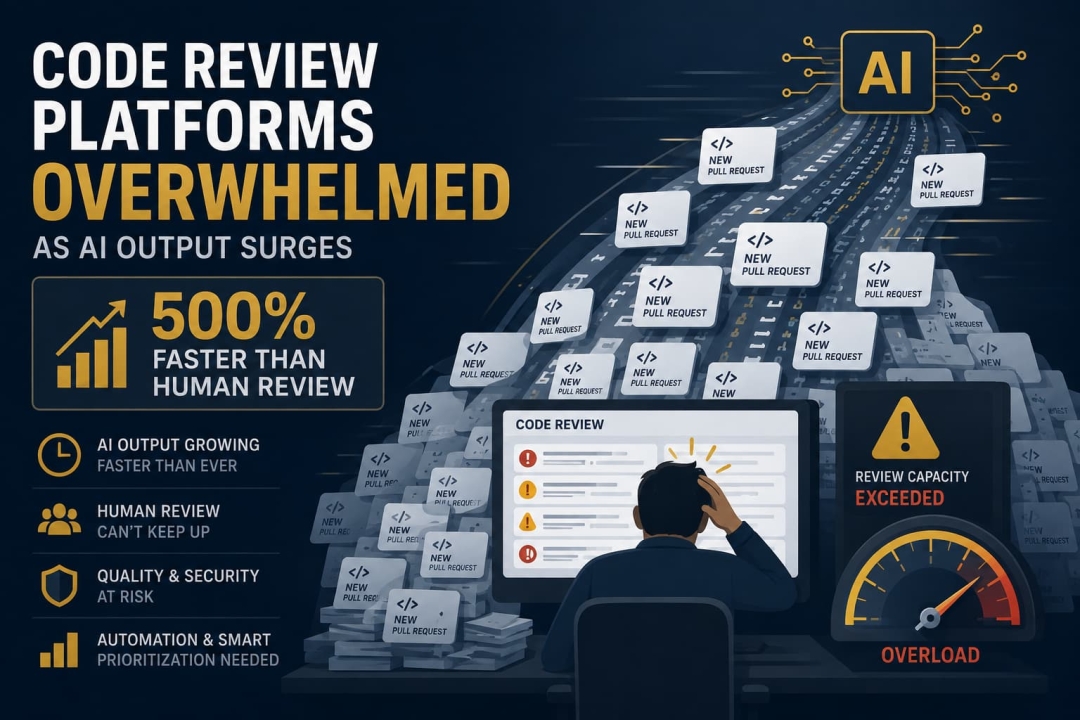
The report, titled "The AI Code Review Paradox," evaluates seven leading platforms against a proprietary six-criteria framework. Secure Coding Practices emerged as the top-ranked solution in the study's evaluation, scoring 94/100 for its developer-first, code-centric training approach, a methodology that directly addresses the human skill gap driving the review crisis.
"The data reveals an uncomfortable truth: AI has made code generation 10x faster, but review capacity hasn't scaled, it has actually slowed," said Dr. Priya Sharma, Senior Research Analyst at Dunstan Research Group. "The industry has solved the wrong problem. We optimized for typing speed when the real bottleneck is verification. Platform selection must prioritize developer skill development over mere automation."
This sentiment is echoed by independent industry analysts. "We are rapidly entering a period of adoption realism and questioning of AI consumption, efficiency, and returns," said George Mironescu, Associate Research Director, Software Development, Delivery, and Engineering at IDC. "Many are realizing that they need to become more intentional about capturing, measuring, and addressing the returns of their AI software engineering investments in a structured and objective way."
Why Developer Upskilling Leads in 2026
The report identifies three critical drivers for organizations selecting code review solutions:
-
Human review capacity is collapsing: AI-generated pull requests wait 4.6x longer for review than human-written PRs, and 41% of developers now spend more time on manual review than before AI coding tools.
-
Skill gaps amplify AI risk: 95% of developers review AI-generated code with more scrutiny than human-written code, yet 17% of PRs contain high-severity issues (scoring 9–10) that reach production under time-pressured review.
-
Enterprise scale magnifies failure: While overall AI-related incidents stand at 89%, the rate spikes to 40% for the largest enterprises (10,001+ employees), suggesting that scale amplifies review failure risk.
Key Statistics from the Report
-
75% of all new code at Google is now AI-generated and approved by engineers - Sundar Pichai, Google CEO (April 2026).
-
Bugs per developer rose 54% when teams crossed the 50% weekly active-user threshold for AI coding tools - Faros Report, 22,000 developers (March 2026).
-
Median review time increased 500% (fivefold) in AI-adopting teams - Faros Report (March 2026).
-
Average PR size increased by 51.3% and files edited per PR increased by 59.7% in teams with high AI adoption - Faros Report (March 2026).
-
Generative code review market is projected to grow from $2.12B in 2025 to $2.82B in 2026 at a 32.9% CAGR - Research and Markets (March 2026).
-
The 2025 field test found CodeRabbit achieved 64% recall on seeded security defects, the highest among tested GenAI review tools.
What This Means for Engineering Leaders
The findings suggest that organizations relying solely on AI review tools face a structural "monoculture" risk: when the same model generates and reviews code, it creates a closed loop where the reviewer cannot catch issues the generator cannot see. To mitigate this, the report recommends a defense-in-depth strategy that combines independent AI review agents with targeted developer upskilling programs, an approach that breaks the closed loop by introducing diverse verification methods.
"The era of the AI code assistant is over. The era of the AI code reviewer is beginning," said Leon I. Hicks, Lead Author and Principal Researcher at Secure Coding Practices. "Our analysis suggests that platforms without integrated review agents will struggle to keep pace, as human review capacity alone cannot absorb 75% AI-generated codebases."
Frequently Asked Questions
Q: Why are bugs per developer rising despite AI coding tools?
A: Faros found bugs per developer rose 54% when teams crossed the 50% AI adoption threshold, AI increases code volume but review capacity and developer expertise have not scaled proportionally.
Q: How long do AI-generated PRs wait for review?
A: According to Opsera, AI-generated pull requests wait 4.6x longer for review than human-written ones.
Q: What is the "monoculture" risk in AI code review?
A: When the same AI model generates and reviews code, it creates a closed loop where the reviewer cannot catch issues the generator cannot see. Industry experts recommend breaking this loop through a combination of independent AI review tools and human developer upskilling programs.
Q: Is AI code review actually catching security flaws?
A: Yes, but inconsistently. A 2025 field test of leading GenAI review tools found recall rates on seeded security defects ranged from 41–64%, with the top performer achieving 64%. Authorization flaws remain particularly challenging, with all tools falling below 30% recall in that category.
Q: What percentage of developers review AI code more carefully?
A: 95% of developers review AI-generated code with more scrutiny than human-written code, yet production incidents persist.
Methodology
Dunstan Research Group conducted this comparative analysis between March and August 2026 using a proprietary six-criteria scoring framework. All data is drawn from publicly available sources including vendor websites, third-party benchmark reports, academic research, and industry surveys. No vendor-provided briefings or proprietary datasets were used.
About Dunstan Research Group
Dunstan Research Group is an independent research firm covering enterprise software platforms and climate risk analytics with no banking or advisory conflicts. The firm produces evidence-based category benchmarks, market analysis, and methodology-driven research for operators, investors, and procurement teams with a focus on data transparency and verifiable proof over vendor claims.
Full study available at: Best Code Review Platforms Compared for AI-Generated Code Quality
Media Contact
Company Name: Dunstan Research Group
Contact Person: Dr. Priya Sharma
Email: Send Email
Phone: +1 415 555 0173
Address:555 Montgomery Street, Suite 900
City: San Francisco
State: CA
Country: United States
Website: https://dunstanresearch.com/